

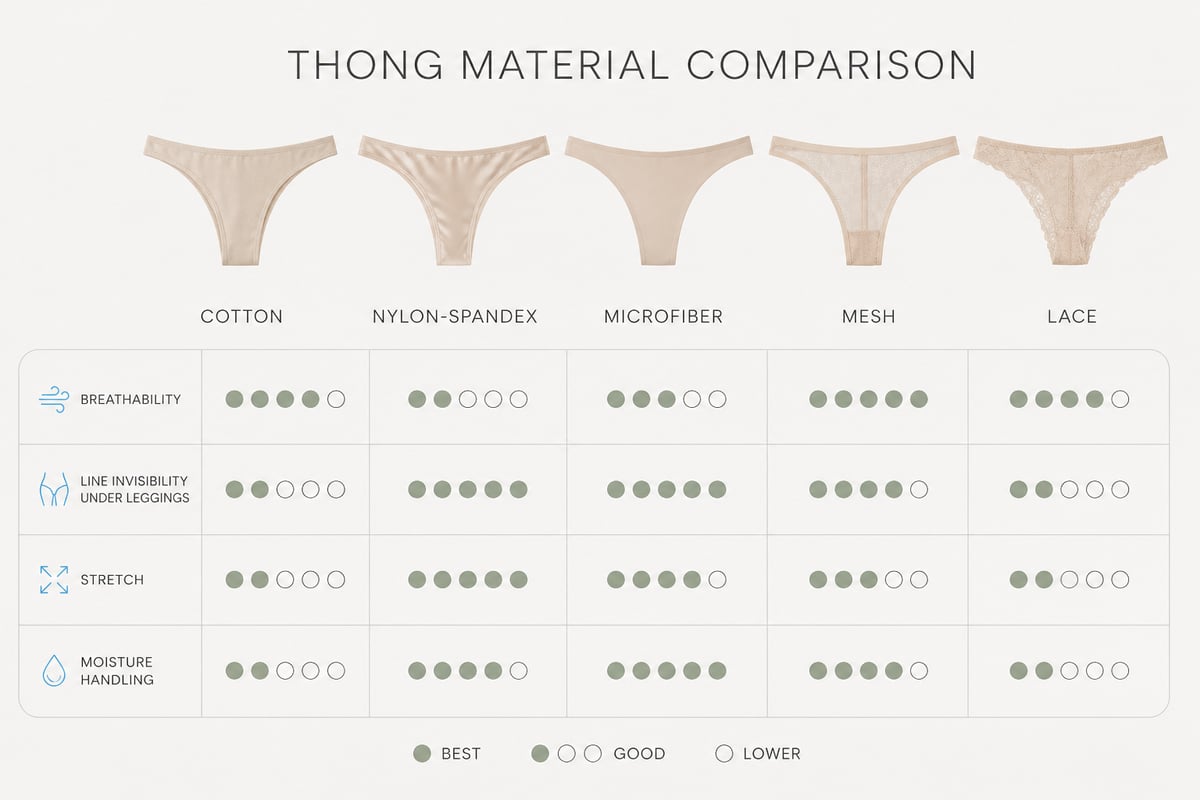
Thong materials fall into a few main groups: natural fibers like cotton and bamboo, stretch synthetics like nylon and spandex blends, and decorative fabrics like lace and mesh. For women who wear leggings and train in fitted clothes, the best choice is usually a smooth, stretchy, breathable knit with a seamless finish, because it stays invisible and moves with you. This guide compares each fabric on breathability, line visibility, stretch and durability so you can match thong materials to how you actually dress and move.
What Is Thong Material?
A thong is a style of underwear defined by its narrow back panel, and its material is whatever fabric makes up the front panel, the waistband and the gusset. Most thongs are knitted from one of three bases: cotton, a nylon and spandex blend, or a modal or bamboo blend.
The fabric matters more in a thong than in a brief because there is less of it. A small front panel has to stay smooth under pressure, absorb moisture, and avoid creating edges that show through leggings. A coarse or rigid fabric has nowhere to hide.
Three properties decide whether a thong works:
- Breathability: how well air and moisture pass through the fabric.
- Stretch and recovery: whether it holds its shape after a squat, lunge or long day.
- Surface and edge finish: whether the fabric lies flat or leaves ridges, seams and visible lines.
Cotton Thongs: Breathable but Not Always Invisible
Cotton is the most widely recommended underwear fabric for breathability, and it earns that reputation for everyday wear. Cleveland Clinic recommends 100% cotton underwear because it is breathable, less likely to trigger an allergic reaction, and helps wick away sweat and moisture. Textile data from Coats Group shows cotton absorbs more moisture than nylon, which is one reason cotton tends to feel less clammy at rest.
The tradeoffs show up in activewear. Cotton holds moisture once it is saturated, so it can feel damp and heavy partway through a hard workout. Plain cotton also tends to have thicker seams and a less smooth surface, which can print through thin leggings.
One detail worth checking is the gusset. Cleveland Clinic notes that a cotton crotch panel in otherwise synthetic underwear does not breathe as well as underwear made entirely of cotton, so a cotton liner does not turn a synthetic thong into a breathable one.
Best for: relaxed days, sleep, and darker or looser bottoms where lines are not a concern.
Nylon and Spandex Blends: The Stretch Workhorse
Nylon and spandex blends are the most common material in performance and seamless thongs, because they stretch in four directions, recover quickly and knit into very smooth surfaces. This is the fabric family behind most invisible-under-leggings designs.
Their strengths are practical:
- Smooth, flat surface that does not catch on leggings or create texture.
- 4-way stretch that follows the body through squats, lunges and yoga.
- Fast drying, which suits sweat-heavy sessions.
- Durability through repeated washing.
The main caution is breathability. Pediatrix & Obstetrix advises against non-breathable synthetics such as nylon and satin for underwear, and notes that thick and woven fabrics can limit airflow compared with lighter knits. The practical takeaway is to look for a thin, open knit or a moisture-wicking finish rather than a dense, slick weave. A fine knit blend breathes far better than a heavy synthetic satin.
For active women, a well-built nylon and spandex knit is often the better compromise: it manages sweat during the session and stays invisible afterward.
Microfiber and Seamless Knits for Invisible Lines
Microfiber and seamless knit thongs are made from very fine synthetic yarns knitted in a tube or with bonded edges, so there are no stitched seams to leave a ridge. They are the fabric of choice when the goal is a line-free silhouette under light or fitted leggings.
Seamless construction changes more than the look. With no side seams, there is less friction at the hip and leg openings, and the edges lie flat against the skin instead of pressing a visible line into it. A lightweight knit also dries quickly, which helps in the gym.
Fabric alone does not prevent camel toe, though. The front panel needs structure so it does not fold or compress under tight leggings. That is why panel design matters as much as fiber choice, and why a smooth fabric with a shaped, structured front performs better than a flimsy one. If you are comparing fits, the guide to seamless thong options for women explains how construction affects comfort.
Ambar Wear builds its thongs around exactly this idea, with a seamless construction and a structured front panel designed to help prevent camel toe, so you can see the full range in the invisible camel toe thong.
Mesh, Ice Silk and Lightweight Synthetics
Mesh and ice-silk-style knits are airy, stretchy fabrics that trade bulk for a cool, almost weightless feel. They suit warm weather, studio classes and anyone who dislikes the sensation of heavy underwear.
Mesh panels add ventilation, which partly offsets the low breathability of synthetics. The open structure lets air move and moisture escape, and it keeps the fabric thin enough to disappear under fitted bottoms.
The Seamless Ice Silk Thong is a good example of this category. This mid-rise, minimalist design is made from soft, breathable fabrics with mesh detailing, and its stretchy fit is designed to hug the body with minimal bulk, which makes it a practical pick under leggings, dresses and activewear.

Before you buy, check the full details on the Seamless Ice Silk Thong product page, including the available sizes.
Lace Thongs: Style First, Practicality Second
Lace is a decorative fabric, usually a nylon or polyester net with a raised pattern, and it works best when appearance is the priority over performance. It looks refined and feels light, but its texture is the problem under leggings.
The raised pattern and scalloped edges can print through thin or light-colored fabric, and lace tends to stretch less smoothly than a knit. Under fitted workout clothes, that often means visible texture lines.
For leggings, yoga pants and training wear, lace is a poor match. It is better reserved for dresses, skirts and looser trousers, where the edge details will not show through. If you want a lace look for the evening and a smooth knit for the day, keeping both in rotation is a sensible approach.
Bamboo, Modal and Other Natural Alternatives
Bamboo, modal, hemp and linen are natural or semi-natural fibers that offer a softer, silkier hand than standard cotton. Pediatrix & Obstetrix identifies cotton, hemp, bamboo and linen as natural fabric options for underwear, and they share cotton's breathability advantage.
Bamboo and modal knits tend to be smoother than cotton jersey, which helps them lie flatter under leggings. They also drape well and feel gentle against skin, so they suit sensitive wearers who find rougher fabrics irritating.
Their limits are durability and recovery. Natural-fiber blends can lose shape faster than nylon and spandex, so they work best blended with a small percentage of elastane for stretch. For a thong you plan to wear to training, look for that blend rather than a pure natural knit.
How to Choose Thong Materials for Your Routine
The right fabric depends on what you do in the thong, so match the material to the activity rather than choosing one fabric for everything. A simple framework covers most situations:
- Heavy sweat sessions (HIIT, CrossFit, hot yoga): a thin nylon and spandex knit with moisture-wicking properties.
- Light-colored leggings: a seamless microfiber or ice-silk knit with a structured front panel.
- Low-impact days and sleep: cotton or a bamboo-modal blend for maximum breathability.
- Dresses and special occasions: lace or mesh, where texture will not be an issue.
Pay attention to fit as well as fabric. A thong that is too tight in any material will dig in and create lines, and one that is too loose will shift during movement. The overview of thong sizes is a useful starting point for getting the cut right.
Fabric, Fit and Vulvar Comfort
Fabric choice affects comfort and skin health, but thongs themselves are not the problem. A 2019 study cited by Healthline found no evidence that thong use is associated with yeast vaginitis, bacterial vaginosis or urinary tract infections.
What matters more is moisture and friction. Medical experts commonly note that tight synthetic clothing, seams and gusset absorbency can affect vulvar comfort. Choosing a thin, flat-seamed, breathable knit and avoiding anything that feels abrasive is a reasonable response.
Good hygiene habits support whichever fabric you choose:
- Change underwear at least daily, and sooner if it gets wet or stained, as Cleveland Clinic advises.
- Change out of sweaty workout underwear soon after training.
- Wash new underwear before the first wear, using a fragrance- and dye-free hypoallergenic detergent, per the same guidance.
Caring for Your Thongs to Keep the Fabric Performing
Proper care preserves stretch, smoothness and moisture control, so a good thong keeps performing after dozens of washes. Heat and harsh products are the main enemies of elastic fibers.
Practical habits that protect the fabric:
- Wash in cool or lukewarm water on a gentle cycle, ideally inside a mesh laundry bag.
- Skip fabric softener, which can coat synthetic fibers and reduce wicking.
- Air dry or use a low-heat setting, since high heat degrades spandex and causes the edges to curl.
- Rotate several pairs rather than wearing the same one repeatedly, which lets the elastic recover.
Replace any thong that has stretched out, pilled heavily or lost its front-panel structure, because a worn pair will no longer sit flat and invisible.
FAQ
What are the different kinds of thongs?
Thongs are generally grouped by rise and coverage: low-rise, mid-rise and high-rise cuts, plus variations like seamless, lace and tummy-control styles. They can also be sorted by fabric, such as cotton, nylon-spandex or mesh. The right type depends on your bottoms and activity.
What's the difference between G-strings and thongs?
A thong has a small triangle of fabric at the back and typically a wider waistband, while a G-string uses a thin string or cord with minimal fabric at the hip. Thongs offer slightly more coverage and are usually more comfortable for all-day wear. For training and fitted clothes, a thong is the more practical choice.
What constitutes a thong?
A thong is underwear with a front panel and a narrow strip of fabric at the back that passes between the buttocks, with no fabric covering the cheeks. The cut can vary in rise and width. What separates it from other styles is that minimal back coverage.
Start by checking which fabric is in the pairs you wear most under leggings, and set aside any with thick seams, lace trim or a dense woven feel. When you are ready to replace them, Ambar Wear offers seamless thongs built with a structured front panel, stretch and breathable, moisture-wicking fabric, backed by a return policy if you do not feel the difference on your first wear. The Seamless Ice Silk Thong is a good place to begin, and you can shop now at Ambar Wear to find the fabric and fit that suit your routine.