

The best womens underwear fits without digging or bunching, uses a breathable fabric, and has a cut that suits what you wear over it. For leggings, yoga pants and fitted clothes, that usually means a seamless construction with a smooth front panel, since seams and loose fabric are what create visible lines and camel toe.
This guide covers the main styles and what each one does, how to compare fabrics, how to confirm a proper fit, and how to build a practical drawer for training and everyday wear.
What Is Ladies Underwear Called?
Ladies underwear is called panties, underwear, undies or knickers, depending on the region and the style. In the United States, "panties" and "underwear" are the common terms, while "knickers" is more typical in the United Kingdom. Retailers also use "briefs" for a specific cut, which is a separate question from the general name. Casual terms like "undies" appear on packaging and in everyday speech, though product listings usually stick with "underwear" or "panties" for search clarity.
The vocabulary matters mostly for shopping. A product labeled "hipster" or "boyshort" describes a cut, and a product labeled "seamless" or "cotton" describes construction or fabric. Knowing which word describes which feature makes filtering a catalog much faster. For example, a search for "seamless thong" combines a construction term with a cut, while "cotton brief" pairs a fabric with a cut, and each narrows results in a different way. Terms such as "bikini" and "high-cut" can also vary between brands, so check the product photos and size notes before assuming a label means the same thing everywhere. If you want a broader look at naming and categories, Ambar Wear's piece on women's underwear and panties breaks them down.
The Main Styles of Womens Underwear
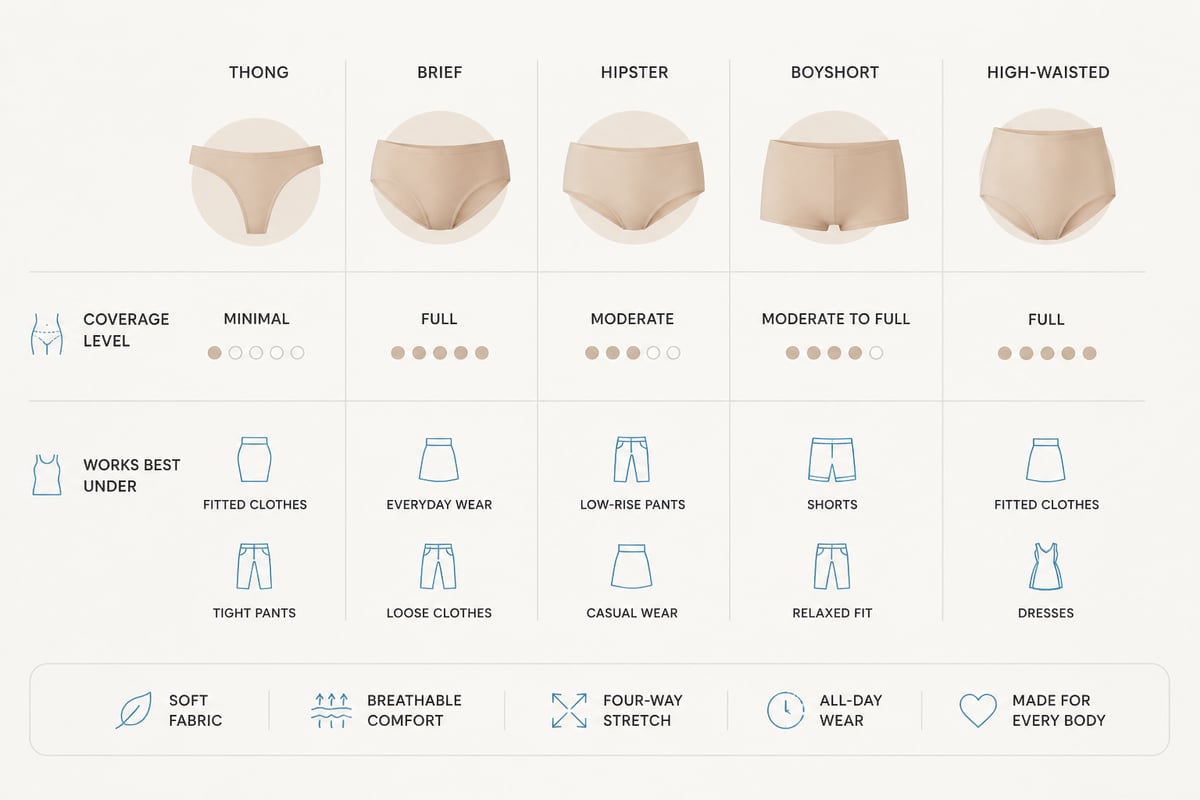
Each style of womens underwear trades coverage against line visibility, and the right one depends on the clothing worn over it. Here is how the core cuts compare.
| Style | Coverage | Best under | Watch for |
|---|---|---|---|
| Thong | Minimal rear coverage | Leggings, fitted dresses | Waistband that rolls or digs |
| Brief | Full rear, mid-rise | Loose pants, daily wear | Leg bands that show through thin fabric |
| Hipster | Moderate, sits on the hip | Jeans, casual wear | Side seams visible under tight fabrics |
| Boyshort | Full coverage, longer leg | Skirts, dresses, anti-chafe | Bulk under snug leggings |
| High-waisted | Full coverage to the navel | Fitted tops and bottoms | Thick bands that print through |
Briefs Versus Hipsters
The difference between briefs and hipsters is the rise and the leg opening. Briefs sit higher on the waist and cover more of the hip and rear, while hipsters sit lower on the hip bone with a lower rise and a slightly higher cut at the leg. Briefs give more coverage and a more secure feel, and hipsters tend to be less visible under low-rise bottoms.
Neither is automatically better for fitted clothing. What causes lines is the edge finish, not the name of the style. A hipster with a thick stitched hem prints through leggings, while a brief with a bonded, laser-cut edge can disappear. For a deeper comparison, see this look at brief women's underwear.
Thongs for Leggings and Workouts
A thong removes the rear leg band, which is the single most common source of panty lines under fitted pants. That makes it a popular choice for yoga, pilates and gym wear, especially in light-colored leggings. A comfortable thong has a flat, soft waistband, a narrow but stable back, and enough stretch to move with you. Comfort thong underwear covers what to look for in detail.
What's the Best Material for Underwear?
The best material for underwear is a breathable fabric that wicks moisture and sits softly against skin, and for everyday wear that is often cotton. Cleveland Clinic recommends 100% cotton underwear for regular wear because it is breathable and less likely than synthetic fabric to trigger an allergic reaction, and it says non-cotton underwear is fine occasionally.
Cotton is not the only option, and it is not always the best one for exercise, where it can hold moisture. An expert interview from Katie Couric Media names silk, hemp and linen as natural-fiber alternatives and notes that nylon feels soft and dries quickly. That quick-drying quality is why many active women choose performance blends for training days.
Fabric Choices at a Glance
- Cotton: breathable and gentle, a sound everyday default, though it can stay damp after heavy sweating.
- Nylon and spandex blends: smooth, stretchy and quick-drying, which suits workouts and fitted clothes.
- Silk, hemp and linen: natural alternatives with their own feel, usually at a higher price.
- Moisture-wicking technical fabric: designed to move sweat away from skin during training.
Construction counts as much as fiber. A seamless knit with bonded edges removes the stitching that creates ridges under leggings. Ambar Wear's underwear uses seamless construction with breathable, moisture-wicking fabric and stretch, so it stays in place through squats, lunges and yoga. You can read more about the approach in this guide to seamless underwear.
How to Find the Right Fit
The right fit means the waistband and leg openings lie flat without cutting into skin, and the fabric stays put when you move. Underwear that is too small digs in and creates the very bulges and lines people try to hide. Underwear that is too large bunches, shifts and wrinkles under clothing.
ACOG advises wearing underwear and pants that are not tight-fitting to allow air to circulate. Snug is fine, but you should not see deep marks on your skin at the end of the day.
Use this quick fit check:
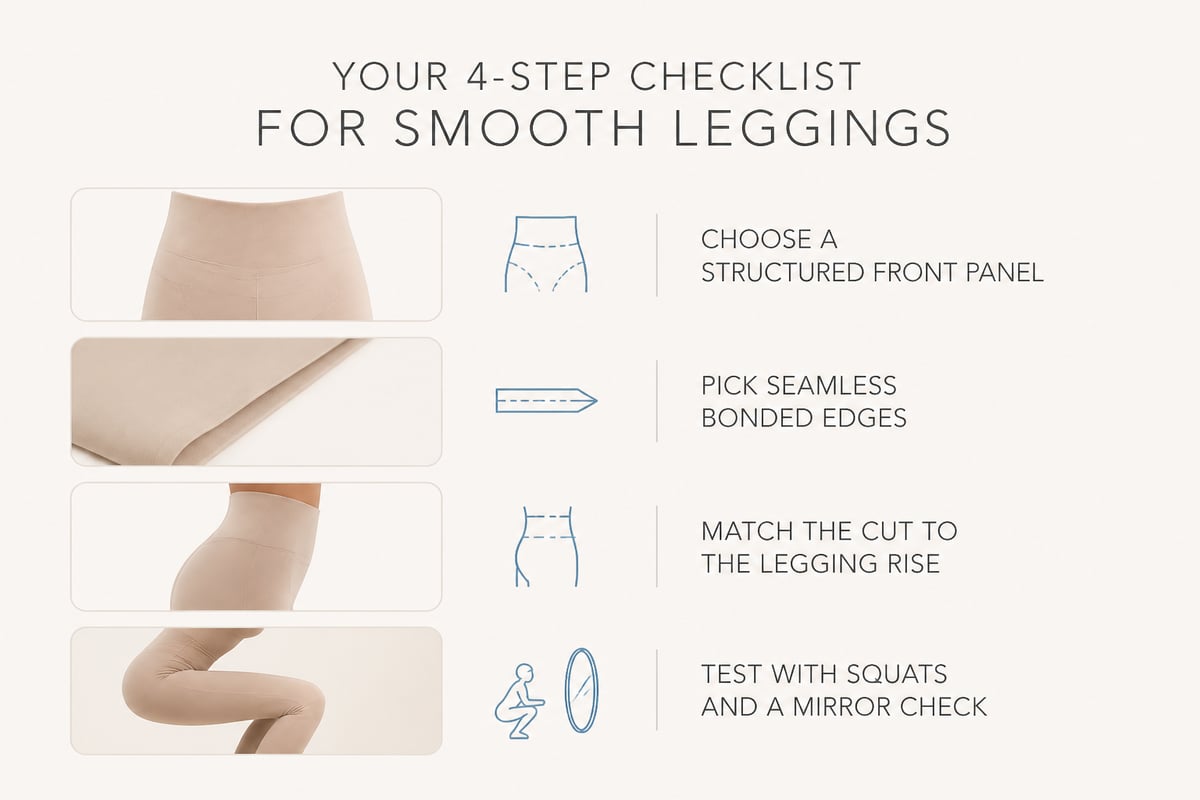
- Put the pair on and check the waistband and leg openings for pinching or deep indentation.
- Squat, lunge and bend forward to confirm nothing rides up or rolls down.
- Wear them under your actual leggings or fitted pants and look in a mirror from the side and back.
- Check the front panel for flat, smooth fabric with no bunching.
- Wear them for a full day before deciding, since fit changes as you sit, walk and train.
Sizing varies between brands, so check each size chart rather than assuming your usual size. This overview of women's panties sizes explains how to read them.
Camel Toe and Visible Lines Under Fitted Clothes
Camel toe happens when thin, stretchy pants press fabric against the body and show the contour at the front, and underwear that is too thin, too loose or poorly shaped makes it more visible. Panty lines happen when seams, elastic or leg bands press into skin and print through the pants.
The fix is in the underwear's design. A structured front panel creates a smooth surface under tight fabric, and seamless edges remove the lines that show through. Ambar Wear's underwear is built with a structured front panel designed to reduce camel toe, and it is intended to stay low-visibility under leggings, including light colors. Its guide to underwear for leggings gives more detail on pairing the right cut with the right bottoms.
If you are choosing between going without and wearing something designed for the job, the trade-offs are laid out in this look at leggings without underwear. The practical point is that underwear built for fitted clothing solves the visibility problem without giving up hygiene or comfort.
Underwear for Workouts and Active Days
Underwear for training should wick moisture, stay in place during movement, and avoid seams that rub. Gym, pilates, yoga and CrossFit all involve stretching, squatting and repetitive motion, which is where bunching and chafing show up.
Look for these features:
- A secure, flat waistband that does not roll when you bend or twist.
- Moisture-wicking fabric so sweat does not sit against skin.
- Four-way stretch that moves with deep squats, lunges and floor work.
- Bonded or laser-cut edges with no bulky leg elastic.
- A smooth front panel that stays flat under compression leggings.
Hygiene matters more on active days. Harvard Health's guidance on vulvar care covers underwear, laundry products and changing after exercise, and changing out of damp workout clothing promptly is a sensible habit. Ambar Wear's underwear uses breathable, moisture-wicking fabric intended to keep you fresh through a full day, and its active underwear guide goes further on training-specific choices.
How Many Pairs of Underwear Should a Woman Own?
Most women are well served by roughly 10 to 14 pairs, which covers a week or two of wear without doing laundry daily. That range is a practical rule of thumb and not a medical standard. The right number depends on how often you wash and how often you train.
Cleveland Clinic recommends changing underwear at least once daily, and more often if it becomes wet or stained. If you work out most days, that can mean two pairs a day, so active women should lean toward the higher end or add a few extra performance pairs.
A simple drawer breakdown:
- Everyday pairs: a few soft, breathable pieces for regular days.
- Fitted-clothing pairs: seamless options for leggings, yoga pants and tight bottoms.
- Training pairs: moisture-wicking pairs you can rotate through the week.
- A few backups: extra pairs for days you change after exercise.
For ideas on assembling a matching drawer, a guide to underwear sets is a useful reference.
Caring for Your Underwear
Caring for underwear well keeps fabric soft, preserves stretch and reduces irritation. Cleveland Clinic advises washing new underwear before wearing it and choosing fragrance- and dye-free hypoallergenic detergent if laundry products irritate the vulva. Washing new pairs removes finishing residues left from manufacturing and handling, and a gentler detergent lowers the chance of a reaction on sensitive skin. Rinsing thoroughly matters too, because leftover detergent can linger in fabric that sits against skin all day.
A few habits extend the life of seamless and performance pieces:
- Wash in cold or warm water on a gentle cycle, using a mesh bag to protect bonded edges. Fasten any hooks on bras or zippers on leggings first so they cannot snag the fabric.
- Skip fabric softener, which can coat technical fibers and reduce moisture wicking.
- Air dry or use low heat, since high heat degrades stretch fibers over time. A drying rack away from direct sun keeps elastic from becoming brittle.
- Replace pairs when the waistband stretches out, the fabric thins, or edges start to curl.
Wash sweaty workout pairs soon after wearing, rather than leaving them balled up in a gym bag, so moisture and odor do not set into the fabric.
FAQ
Is it better to wear a thong or a brief under leggings?
A thong usually produces fewer visible lines because it has no rear leg band, while a seamless brief with bonded edges can be equally invisible. Choose based on comfort and on the thickness of your leggings, then run the squat and mirror test before committing.
Should I wear underwear to the gym?
Yes, most women prefer to, since underwear adds a hygienic layer between skin and workout clothing and helps with moisture. Pick a seamless, moisture-wicking pair with a secure fit so it does not shift during movement.
How often should I replace my underwear?
Replace a pair when the elastic loosens, the fabric thins, the color fades unevenly or it stops holding its shape. For pairs worn and washed often, that tends to be every year or so, though performance fabrics and careful washing can extend that.
Start by trying one seamless pair under your lightest-colored leggings and run the squat and mirror test from the fit checklist above. If you want underwear built for exactly that situation, with a structured front panel and seamless edges, shop now at Ambar Wear and find the pair that suits your training and everyday wear.